Mechanised Sheep Handling Devices in Australia

Updated: Jun 1
Welfare Risk, Scientific Gap, and Regulatory Failure Assessment
Compiled and written Sheep Advocate Australia
1. Executive Summary
This report documents significant welfare concerns associated with the use of mechanised sheep handling devices across Australia, with a primary focus on systems that restrain, clamp, and mechanically invert animals.
Evidence gathered demonstrates that:
· Sheep are subjected to mechanical compression, particularly across the rib cage.
· Animals are fully inverted and suspended, removing all physical control.
· Dynamic forces occur during rotation, increasing loads beyond static compression.
· Devices operate across a wide spectrum, including hydraulic systems, manual clamp devices, and crude homemade equipment.
Despite this:
· These systems are not explicitly addressed in current national welfare standards.
· There is no evidence of biomechanical validation for sheep.
· Advisory bodies, including the Animal Welfare Task Group (AWTG), have not identified or assessed these devices.
· This represents a clear regulatory and scientific gap.
2. Industry Context and Device Landscape
Mechanised sheep handling equipment is widely used across Australian sheep operations, with manufacturers such as Peak Hill Industries, Offsider Ag Equipment, and Clipex.

These systems aim to:
· Reduce labour.
· Increase throughput.
· Standardise handling.
However, the rapid expansion of these technologies has not been matched by welfare assessment or regulation.
After studying the industry more closely, and reviewing a large amount of American material, it appears that many sheep-holding machines have evolved almost entirely out of the cattle industry. Their original purpose was to restrain cattle during dehorning, castration, and medical procedures. Because of this origin, most available technical discussion relates to cattle, with very minimal data specific to sheep.
There is essentially no regulation, no national standard, and no welfare reference to these machines in Australia. In the United States, there is only passing mention of sheep-hold devices, and even that is extremely limited. Concern has been noted regarding over-compression in cattle handling systems, but that concern has not been translated into any sheep-specific welfare framework in Australia.
3. Device Classification
Devices observed fall into the following categories:
Category A – Air Rotate Systems (Extreme Risk)

· Hydraulically operated systems.
· Clamp + invert.
· Manufacturer Video: https://www.youtube.com/watch?v=xTZd_eeE1k4&autoplay=1
Category B – Hydraulic Loader Compression Systems

(Moderate/High Risk)
· Plate-based restraint.
· Multi-point compression.
· Manufacture Video:
Category C – Immobilisers / Crush Devices (High Risk)
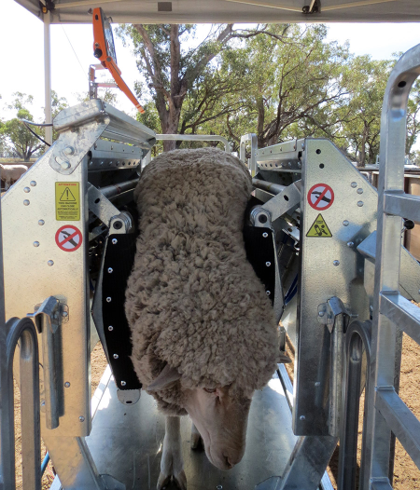
·. Full-body containment.
· Limited movement.
· Manufacturer video:
Category D – Manual Turnover Systems

(Moderate/Moderate Risk)
· Operator-driven inversion.
Category E – Homemade Devices (Critical Gap)
· No engineering controls.
· No standardisation.

4. High-Risk Devices — Air Rotate Systems (Primary Concern)
Air rotate systems present the highest level of welfare concern.
Watch manufactures Video:
4.1 Rib Cage Compression
Clamp mechanisms apply force directly to the thoracic region, often through narrow contact points, increasing pressure concentration.
4.2 Full Body Suspension
Animals are lifted off the ground, transferring body weight into clamp contact zones.
4.3 Dynamic Loading During Rotation
The rotation phase introduces:
· Gravitational force.
· Acceleration.
· Animal resistance.
This results in combined mechanical loading beyond static compression levels.
4.4 Combined Force Amplification
Forces are cumulative:
· Clamp pressure.
· Body weight.
· Motion.
This creates amplified load on tissues and skeletal structure.
The extreme flipping and body rotation observed in air rotate footage indicates clear reason for alarm. The aggressive clamping by the hydraulic system and violent swinging of sheep into the operator’s position are deeply concerning. Sheep are thrown into the air, rotated from the back to the front, with no evidence of any hydraulic set point to stop pressure on the ribcage.
The machine’s lifting and inversion motion suggests significant compression is required to hold the animal, with full body weight bearing down on metal bars pressed against the ribcage. From observation, there is a high likelihood of internal damage, broken bones, and severe stress responses.
5. Mechanical Risk Analysis
5.1 Static vs Dynamic Compression
Static restraint does not account for forces generated during movement and resistance.
5.2 Landing Force (Critical Concept)
The highest risk occurs at the moment of engagement and rotation, where force is rapidly applied.
The only significant technical information retrieved refers to an indicative compression rating of approximately 90 PSI as standard operating pressure, with up to 120 PSI claimed as a maximum safe pressure. This appears to be the accepted benchmark across most machines. However, there is no available research establishing what a safe compression pressure is for sheep.
There is nothing defining sheep-specific thresholds for:
· Ribcage tolerance.
· Spinal vulnerability.
· Thoracic trauma.
· Abdominal pressure thresholds.
This absence of scientific basis highlights the fundamental problem: these devices are completely unregulated, undocumented, and unassessed in Australia.
It is the opinion of Sheep Advocate Australia that the greatest welfare risk is not the holding pressure that keeps the sheep still, but the initial landing pressure — the force that first clamps onto the animal. No manufacturer provides data on this. None of these machines appear to account for multiplied force when an animal panics, struggles, attempts to jump, or braces against the clamp.
5.3 Load Concentration
Small contact areas increase pressure intensity on the rib cage.
5.4 Misalignment of Pressure Zones
Variation in sheep size results in inconsistent alignment of compression points.
Newer Peak Handler machines claim to use ‘laser eye’ technology to automatically detect animal size and adjust pressure accordingly. However, after reviewing the footage collected, and based on basic physics, it is unclear how this technology could effectively account for sheep of vastly different heights, widths, ages, and wool densities.
In several videos, many sheep are taller than the compression zone of the machine itself. That means the point of contact and the compression force is landing on different anatomical locations depending on the animal’s size.
5.5 Multi-Point Force Interaction
Machines and operators often apply force simultaneously, increasing overall load.
ShearEzy and loader/cradle systems present a multitude of concerns. Sheep are walked into loaders between two tall flat plates that close with uncertain pressure levels. Animals are forced downward before being rotated upside down and slide through to a metal shearing rack. During shearing, the rear mechanism rotates while the torso remains fixed - a design that risks twisting the sheep’s spine or limbs.
Video examples show moments where operators lose control, leaving sheep hanging awkwardly, with legs still bound. The lack of safety tolerance for error or malfunction is alarming. Overall, the mechanical rigidity and poor restraint design create serious risk for broken ribs, torn ligaments, and distress.
Manufacture Video: https://www.youtube.com/watch?v=F0-qWLiUro8&autoplay=1
6. System Failure Risks
· No visible force thresholds or limits.
· Sensor systems lack transparent
validation.
· Risk of malfunction or miscalibration.
Another major concern is the fail-safe position if a sensor fails. If a laser is blocked by wool, dirt, moisture, grease, handprints, or contamination, the machine may not detect size correctly. Nothing on record explains what the fail-safe is, if any exists.
Prior to Peak Industries machines becoming the promoted modern standard, many systems were manually operated. Some use simple foot pedals, meaning compression force is entirely dependent on operator strength. There are no set points, no stopping limits, and no mechanical governor to ensure safe compression.
7. Secondary Injury Risks
· Impact with rails.
· Limb strain.
· Spinal stress.
· Dragging during positioning.
In shearing machine footage, animals are thrown aggressively through the system. Sheep are flipped into the air. When dragged back under the machine after shearing, sheep strike a guardrail. Each collision multiplies the force onto ribs, spine, pelvis, and soft tissue. It is not unreasonable to conclude that total force on the animal, including machine impact and animal momentum, could exceed the advertised maximum pressure claims.
8. Throughput and Operational Pressure
Systems are designed for high-volume processing:
· Rapid cycling.
· Minimal handling time.
This reduces opportunity for:
· Monitoring.
· Adjustment.
· Welfare intervention.
Manufacturers proudly advertise approximate throughput figures of 1000 sheep per day. While promotional videos rarely show the full-speed operation, the fact that speed is a primary selling point is deeply alarming.
Comments from sheep farmers on Sheep Advocate Australia pages have also expressed alarm. Many have stated that traditional board-shearing provides far calmer handling and that sheep relax on a slipboard.
These machines remove calm handling entirely and add hydraulic noise, metal-on-metal impacts, compressed gripping, rapid motion, and mechanical unpredictability.
9. Regulatory and Policy Gap
· Not explicitly referenced in national
sheep standards.
· Not addressed during previous
standards reviews.
· Not publicly assessed by advisory bodies
such as the AWTG.
9.1 Implications
· No limits on compression force.
· No guidance on inversion practices.
· No standardised design requirements.
A very important concern is that during previous amendments of the sheep national standards, these devices were not raised or mentioned. Given the extensive roll-out of all these machines, that omission is difficult to reconcile with the reality of current industry practice.
There are claims that some of these devices have been in circulation for at least 20 years. Their absence from standards and policy discussion suggests either a major oversight or a failure to properly assess existing handling technologies.
The failure of the Animal Welfare Task Group (AWTG) to raise these machines is also significant, given its role in the development of standards and welfare policy. The same concern applies to the lack of mention within codes of practice and other welfare frameworks.
10. Unregulated Device Landscape
Evidence shows:
· Widespread use of older devices.
· Crude and modified equipment.
· Inconsistent design.
This results in a fragmented, unregulated environment with no baseline welfare protections.
Many old crude air rotate devices remain in wide use across Australia, especially Peak Hill Industries devices and older versions of those systems. Homemade devices have also been identified. This adds another layer of concern because design variability directly affects the point of contact, force application, and movement arc experienced by the animal.
Crude devices often lack padding, force gauges, limiters, or other engineering controls. Exposed mechanical parts, narrow bars, crude pivots, and hard metal restraint points increase the likelihood of pain, injury, and inconsistent handling outcomes.
11. Closing Request and Call to Action
Sheep Advocate Australia formally calls on all State and Federal Agriculture Ministers to urgently acknowledge and address the regulatory and scientific failure outlined in this report .
The widespread use of mechanised sheep handling devices - particularly systems involving compression, inversion, and dynamic mechanical loading - has developed in the complete absence of validated welfare standards, biomechanical assessment, or enforceable regulatory controls.
Formal Acknowledgement Request
Sheep Advocate Australia respectfully requests:
· A formal written acknowledgement of this report within fourteen (14) days of receipt; and
· A subsequent formal response
outlining the actions that will be taken
by the relevant Federal Minister and/or
governing bodies in relation to the
concerns raised.
Sheep Advocate Australia is prepared to allow this process to occur in good faith and will withhold the commencement of public campaigning or awareness activities pending receipt of this formal response.
Requested Actions
1. Immediate National Review
That an urgent, independent national review be commissioned into the use of mechanised sheep handling devices, with specific focus on:
· compression forces applied to the
thoracic region
· inversion and suspension practices
· cumulative and dynamic loading during
operation
2. Interim Welfare Safeguards
Pending the outcome of this review, the immediate introduction of precautionary measures, including:
· suspension or restriction of high-risk
systems (particularly air-rotate devices)
3. Scientific Validation Requirement
That no device be permitted for use unless it has undergone:
· independent biomechanical testing
· species-specific validation for sheep
· transparent publication of safety
thresholds
4. Regulatory Inclusion
That mechanised handling systems be explicitly incorporated into:
· the Australian Animal Welfare
Standards and Guidelines for Sheep
· all corresponding State Codes and
legislative frameworks
Review Process and Advisory Group
As part of the review process, Sheep Advocate Australia formally requests the establishment of a dedicated advisory group to ensure a structured, transparent, and evidence-based assessment.
This advisory group should:
· Operate under clearly defined Terms of Reference, outlining the specific issues to be examined, including mechanical compression, inversion practices, and device safety thresholds.
· Include representation from animal welfare organisations, independent experts, industry stakeholders, and regulators.
· Provide a formal mechanism to review evidence, identify risks, and recommend regulatory outcomes; and
· Ensure that identified welfare concerns are not only discussed but clearly addressed and rectified through enforceable outcomes.
Sheep Advocate Australia would welcome the opportunity to participate in this advisory group and contribute:
· further evidence and documentation.
· direct engagement in discussions to ensure all welfare concerns are fully examined.
Final Statement
The current situation represents a fundamental failure of animal welfare governance.
These systems are already in operation across Australia. Animals are already being subjected to forces that have never been scientifically assessed, within a regulatory environment that does not recognise their existence.
This is not a future risk.This is a present and ongoing welfare issue.
Sheep Advocate Australia calls on Ministers to act decisively, transparently, and without delay.


Comments